
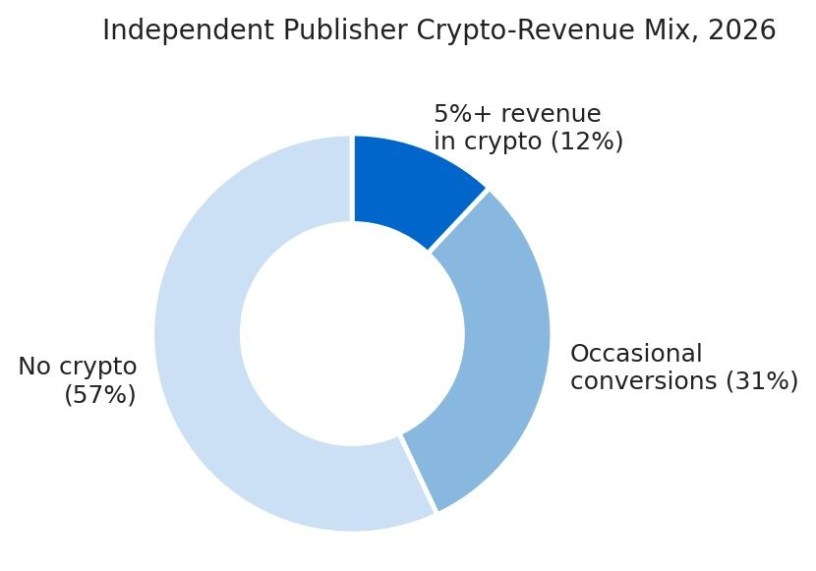
For most of the last decade, independent publishers — the bloggers, newsletter operators, niche-site owners, and one-person media businesses that make up the long tail of digital publishing — handled their finances in two currencies: their local fiat and, occasionally, dollars from a US-based sponsor. By the start of 2026, a meaningful share of them have added a third: stablecoins paid by global advertisers, crypto-denominated affiliate payouts, and tokenized revenue from membership platforms that route payment in USDC, USDT, or selected DAI variants. The volumes are still small in absolute terms but they are no longer rounding errors, and the operational complexity has caught most publishers off guard.
The new revenue mix in 2026
Field surveys conducted across English-language independent publishers in early 2026 show a roughly trimodal pattern. About 12 percent of independent publishers receive at least 5 percent of monthly revenue in some form of digital asset. Roughly 31 percent receive occasional crypto-denominated payments — usually from a single sponsor or platform — that they convert to fiat as soon as practical. The remaining majority handle no crypto directly but increasingly publish content adjacent to the crypto economy, which has its own implications for cash management even when settlement is in dollars.
For the first two groups, the practical issues are surprisingly similar. Each payment arrives in a different wallet or exchange, with a different settlement timing, and frequently in a denomination that does not match the publisher’s home-currency expense base. The cash conversion cycle that was once a one-step affair (sponsor pays, publisher converts to local currency, publisher spends) has become a two- or three-step process with embedded FX-like risk between each step.
What publishers are getting wrong
The most common pattern is what veteran finance teams call “incidental position-taking” — accumulating crypto exposure not because of any intentional strategy but because conversion friction or tax-event aversion delays the trip back to fiat. A publisher receives 1,200 USDC for a sponsored post, intends to convert it the same day, then ends up holding it for six weeks because the conversion path felt expensive or the platform UI was clunky that afternoon. Six weeks later, USDC is still USDC and worth more or less the same — but the same thing happens with 0.05 BTC paid by a different platform, and there the volatility matters meaningfully.
The fix is not to refuse crypto payments. The fix is to develop a small, repeatable process: a monthly review of all crypto-denominated holdings, an explicit decision about whether to hold or convert, and a documented expectation about future value before any of those decisions get made.
Where AI crypto forecasting fits
This is where probabilistic AI crypto forecasting platforms have started to find a small but loyal user base among publishers. The use case is not speculative trading. It is informed conversion timing. A publisher who knows there is a 65 percent probability of Bitcoin closing within ±8 percent of today’s value over the next 30 days has a basis for deciding whether to convert immediately or wait one to two weeks for a slightly better fiat outcome. The same logic applies to whether they should accept future payments in crypto at the current exchange rate or negotiate fiat payment for a small premium.
Crucially, the math here is small but consistent. A publisher receiving $4,000 monthly in stablecoins and Bitcoin who improves average conversion timing by 1.5 percent per transaction adds roughly $720 per year to net income. That is meaningful at the scale most independent publishers operate, and it is genuinely achievable — not from market timing magic, but from converting at moments when historical volatility patterns suggest the position is unlikely to deteriorate further before the next planned conversion window.
Three things to demand from any AI tool you adopt
The crypto forecasting space is crowded with tools that publish polished marketing copy and very little track-record data. Before adopting any platform — paid or free — verify three things. First, the platform should publish a complete historical record of past forecasts and what actually happened. “We are 85% accurate” is meaningless without a verifiable record. Second, the forecasts should be probabilistic, not binary. “Bitcoin will rise” is a sentiment claim. “There is a 65 percent probability Bitcoin closes between X and Y in 24 hours” is something you can act on. Third, the coverage should match your actual holdings — most independent publishers need stablecoins, BTC, ETH, and a small basket of mainstream altcoins, not exotic coins they will never touch.
The bigger picture for 2026
The interesting development in 2026 is not that publishers are suddenly becoming traders. The vast majority continue to convert crypto to fiat as quickly as practical and reinvest in their own business. The change is that the conversion is now informed rather than reflexive, and the tools that make this possible have moved from the realm of hedge funds into something a one-person publishing operation can reasonably evaluate and use. That is the kind of quiet capability shift that does not generate headlines but does change which independent publishers still exist three years from now and which have quietly drifted into the slow erosion of small unmanaged losses.

