
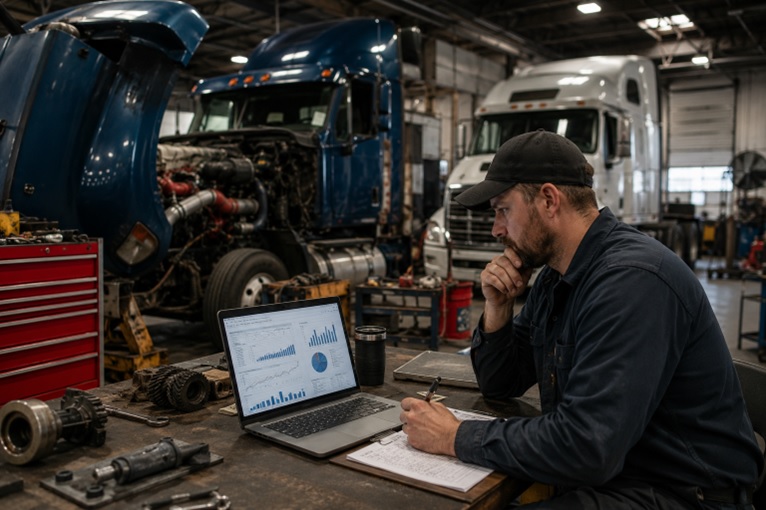
Most heavy-duty diesel shop owners can tell you how busy they are. Far fewer can tell you how profitable that busyness actually is. A shop can run at full capacity, bays booked out for weeks, and still be quietly losing money on a meaningful share of the work coming through the door — the difference usually comes down to whether the owner is tracking the handful of numbers that actually predict profitability, rather than just watching the schedule fill up.
Shop management in the heavy-duty space has its own version of this problem, distinct from general auto repair. Diesel repair work carries longer job durations, more expensive parts, and technicians whose skill level varies enormously — all of which make the standard shop-management instincts less reliable than they’d be in a lighter-duty context.
Key Takeaways
- The billed-to-actual labor ratio is one of the strongest predictors of shop profitability, and most owners have never calculated it for their own operations.
- Diagnostic time is one of the widest efficiency gaps in a diesel shop — often wider than any single repair category.
- Bay turnover matters as much as bay occupancy; a fully booked shop can still be under-earning if jobs move through too slowly.
- Technician productivity and technician efficiency are different metrics that require different fixes when something’s off.
- Shops that track a handful of core KPIs consistently outperform shops relying on instinct, even when both are equally busy.
Why ‘Busy’ and ‘Profitable’ Aren’t the Same Thing
A fully booked schedule feels like success, and often it is — but it isn’t the same signal as profitability, and treating the two as interchangeable is one of the most common blind spots in heavy-duty shop management. A shop can be at full bay capacity while still absorbing significant losses on specific job types, particular technicians, or diagnostic-heavy work that consistently runs over the labor guide’s allotted time.
The gap between busy and profitable almost always traces back to a small number of measurable inefficiencies rather than any single dramatic problem. Diagnostic time is usually the biggest one: a technician who takes three hours to find a fault that should take forty minutes isn’t visibly failing at anything — the truck is still getting fixed, the customer still gets billed — but the shop is quietly eating the difference between billed hours and actual hours spent, job after job.
The Core Metrics Worth Tracking
A small set of consistently tracked numbers reveals far more about a shop’s real financial health than gut feel or a busy parking lot ever will. a framework for the fleet-side labor efficiency metrics that matter most lays out exactly this kind of core KPI set — billed-to-actual labor ratio, technician efficiency versus productivity, and bay turnover among them — and the framework translates directly to independent diesel shop management as well, not just fleet maintenance departments.
The billed-to-actual labor ratio deserves particular attention because it’s rarely calculated in smaller independent shops, despite being one of the clearest single indicators of where margin is actually being lost. A shop consistently billing less than the actual hours spent on jobs is bleeding profitability in a way that’s completely invisible on a busy day, and only becomes visible once someone actually runs the numbers.
Diagnostic Time: The Gap Most Shops Never Measure
Diagnostic work resists the standard flat-rate labor guide model that works well for predictable repairs like brake jobs or scheduled maintenance. A misfire or an intermittent electrical fault can take anywhere from twenty minutes to several hours, depending entirely on the technician’s approach and the shop’s diagnostic tooling — and most shops have no idea what their actual average looks like, because nobody’s tracking it by fault category.
This matters because the fix for slow diagnostics is completely different from the fix for a technician who’s simply idle between jobs, and shops that don’t distinguish between the two tend to apply the wrong solution to both problems. A technician who’s slow specifically on diagnostic work usually needs better tooling or targeted training; a technician who’s idle between jobs usually needs a scheduling fix. Treating both as “the tech needs to work faster” solves neither.
Building a Shop That Tracks What Matters
- Calculate billed-to-actual labor ratio at least monthly, broken out by job type if possible, rather than relying on an overall sense of how busy the shop feels.
- Track diagnostic time separately from repair time in job records, so the two don’t get blended into a misleading average.
- Distinguish technician efficiency (speed on jobs actively worked) from technician productivity (percentage of clocked time spent on billable work) — they require different fixes.
- Review bay turnover alongside bay occupancy; a shop can be fully booked and still under-earning if jobs move through too slowly.
- Start with whichever metric is currently a complete unknown — often billed-to-actual labor ratio — since the biggest gains usually come from measuring something for the first time.
The Bottom Line
A heavy-duty diesel shop that feels busy every day isn’t automatically a profitable one, and the owners who eventually discover the difference the hard way are almost always the ones who never tracked the handful of numbers that would have shown them sooner. Billed-to-actual labor ratio, diagnostic time by fault category, and technician efficiency versus productivity aren’t complicated metrics to start tracking — they just require the discipline to measure instead of assume. Shops that make that shift consistently find the margin they were quietly losing was there to be recovered all along.

